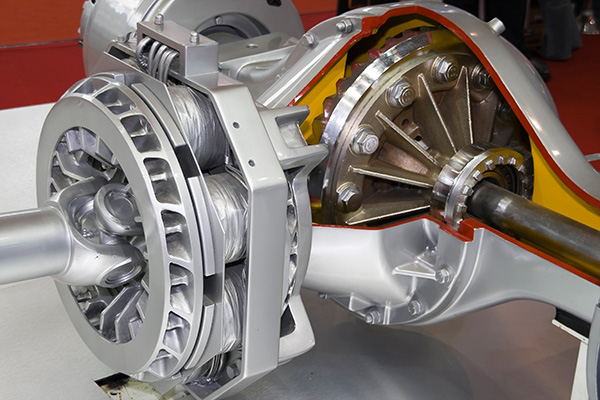
A transfer case sends power from the transmission to both the front and rear axles. It is one of the key components that allows a four-wheel-drive or all-wheel-drive vehicle to move more than one axle at the same time.
The transfer case does not create engine power. It receives torque from the transmission, divides that torque between the axles, and directs it through driveshafts. Depending on the vehicle, it may also provide low-range gearing, allow the driver to select different drive modes, or adjust torque distribution automatically.
How The Transfer Case Connects The Drivetrain
In a rear-wheel-drive vehicle, the transmission usually sends power through one driveshaft to the rear differential. A transfer case adds another path for power to reach the front axle.
The transmission output connects to the transfer case. Inside the case, gears or a chain transmit torque to the front and rear output shafts. Those output shafts connect to driveshafts, which carry power to the front and rear differentials.
The differentials then distribute torque to the wheels on each axle. The transfer case controls power between the axles, while the differentials manage power between the left and right wheels.
Part-Time Four-Wheel Drive
Part-time four-wheel-drive systems are common in trucks, SUVs, and off-road vehicles. These systems often allow the driver to choose between two-wheel drive, four-wheel drive high range, and four-wheel drive low range.
Typical selections include:
- 2H for normal two-wheel-drive operation
- 4H for added traction at regular road speeds
- 4L for slow driving with increased torque
- Neutral for certain towing or service procedures
In 2H, the transfer case usually sends power to the rear axle only. In 4H, it locks or directly connects the front and rear outputs so both axles receive power.
Because the front and rear axles travel different distances during turns, locked four-wheel drive should not be used on dry pavement unless the manufacturer specifically permits it. The drivetrain can bind as the tires attempt to rotate at different speeds. This creates heavy stress on the transfer case, driveshafts, axles, tires, and related components.
What Low Range Does
Low range changes the gear ratio inside the transfer case. The engine turns more times for each rotation of the wheels, which increases torque and gives the driver finer control at low speed.
Four-wheel-drive low range is useful for:
- Steep climbs
- Rock crawling
- Deep mud or sand
- Slow descents
- Pulling through difficult terrain
- Moving a heavy load at very low speed
- Recovering a stuck vehicle
Low range is not intended for normal highway driving. Vehicle speed must remain low, and many systems require the transmission to be in Neutral before 4L can be selected. The correct procedure appears in the owner’s manual.
Full-Time Four-Wheel Drive And AWD
Full-time four-wheel-drive and all-wheel-drive systems are designed to operate on dry pavement. Their transfer cases include a center differential, clutch pack, or similar mechanism that allows the front and rear axles to rotate at different speeds.
Some systems send a fixed percentage of torque to each axle. Others operate mainly as front-wheel drive or rear-wheel drive and transfer additional torque when wheel slip is detected.
Modern systems may use information from:
- Wheel speed sensors
- Steering angle sensors
- Throttle position
- Engine torque
- Transmission gear
- Yaw and acceleration sensors
- Brake system controls
The transfer case or power transfer unit can then adjust clutch pressure and torque distribution. This operation may happen without any action from the driver.
Transfer Case Versus Differential
A transfer case and differential perform related but separate jobs. The transfer case divides power between the front and rear axles. The differential divides power between the left and right wheels on one axle.
A four-wheel-drive vehicle may have a front differential, rear differential, and transfer case. A full-time system may also use a center differential inside the transfer case.
These components require their own lubricants and service procedures. Transfer case fluid is not automatically the same as transmission fluid or differential oil. Using the incorrect product can affect lubrication, clutch operation, shifting, and internal wear.
Common Signs Of Transfer Case Trouble
Transfer case problems can affect engagement, power delivery, and driveline operation. Symptoms vary depending on whether the unit uses gears, a chain, clutch packs, electric motors, vacuum controls, or mechanical linkage.
Warning signs include:
- Difficulty selecting 4H or 4L
- A four-wheel-drive warning light
- Grinding or clunking
- Whining that changes with road speed
- Fluid leaking beneath the vehicle
- Binding during turns
- The vehicle dropping out of four-wheel drive
- Vibration under acceleration
- No power reaching one axle
- A flashing drive-mode indicator
A failed wheel speed sensor, damaged wiring, weak battery, actuator fault, tire-size difference, or control-module problem can produce symptoms that seem like internal transfer case damage. Diagnostic testing should confirm the source before major parts are removed.
Why Matching Tires Are Important
AWD and full-time four-wheel-drive systems can be sensitive to differences in tire circumference. Tires with different sizes, tread depths, inflation pressures, or construction may rotate at slightly different speeds.
The transfer case may interpret that difference as wheel slip and keep an internal clutch applied. Continuous clutch operation creates heat and can accelerate wear.
All four tires should meet the vehicle manufacturer’s requirements. Pressure should remain correct, and tires should be rotated at the recommended interval to keep tread wear even. When one tire is damaged, the remaining tread depths must be measured before deciding whether one tire or several need replacement.
Transfer Case Fluid And Maintenance
Transfer case fluid lubricates bearings, gears, chains, and clutch components. Heat and normal wear gradually contaminate the fluid and reduce its protective properties.
Service intervals vary by design and use. Vehicles that tow, travel off-road, operate in deep water, or carry heavy loads may require more frequent attention. Leaks around output seals, case joints, plugs, and actuator areas should be repaired before the fluid level falls far enough to damage internal parts.
Regular maintenance should include checking the transfer case, driveshafts, universal joints, axle seals, and differential condition. Fluid service must use the exact specification and filling procedure required for the vehicle.
Get Transfer Case Service In Greensboro, NC, With Jeepguys
Jeepguys in Greensboro, NC, can inspect transfer case operation, four-wheel-drive engagement, fluid condition, actuators, driveshafts, differentials, and related controls.
Contact us to schedule service if your vehicle has warning lights, leaks, binding, noise, or difficulty shifting between drive modes.